Still Hours, Sacred Hours: How Parishioners at St. Barbara's Are Returning to the Ancient Practice of Night Prayer
The Pacific darkness settles over Santa Barbara each evening with a particular kind of gentleness. The harbor quiets, the hills soften, and for a brief window between the last notification and the first alarm, something resembling silence becomes possible. It is precisely into that silence that a growing number of parishioners at St. Barbara's Catholic Church are stepping — not by accident, but by intention.
They are reclaiming vigil prayer.
The practice is ancient. Long before digital screens competed for every waking moment, the Church structured the Christian day around the Liturgy of the Hours — a cycle of psalms, Scripture, and prayer that sanctified morning, midday, evening, and night alike. Compline, the final prayer of the day, was sung in monasteries as candles were extinguished. The Office of Readings, once called Matins, was prayed in the depths of night or the earliest hours before dawn. These were not peripheral devotions. They were the heartbeat of Catholic spiritual life for more than a millennium.
For many modern Catholics, however, that heartbeat has grown faint — drowned out by the relentless stimulation of a culture that treats midnight as prime time and sleep as a productivity problem. The recovery happening quietly among St. Barbara's parishioners is, in this sense, genuinely countercultural.
Why Night? The Theology of Vigil Prayer
To understand why Catholics have always prized the night hours for prayer, one must first understand the theological imagination behind vigil. The word itself derives from the Latin vigilia, meaning watchfulness. In the early Church, Christians gathered through the night before major feasts — most especially Easter — in expectant prayer, imitating the disciples who were called to keep watch in Gethsemane. Night was not merely a backdrop; it was a symbol.
Darkness, in the Christian tradition, carries paradox. It is the hour of temptation and vulnerability, yes — but it is also the hour of the Annunciation's hushed mystery, of the shepherds' vigil before angels broke open the sky, of the Resurrection itself, which the Church proclaims occurred before the first light of Easter Sunday. To pray at night is to enter that paradox deliberately, to sit in the tension between darkness and the Light that overcomes it.
Fr. Michael Dolan, who has served the pastoral needs of St. Barbara's parish community for several years, puts it plainly: "When we give God the hours the world considers wasted — the early morning, the late night — we are making a statement about what we believe is most real. We are saying that our first allegiance is not to productivity, but to presence."
Parishioners Who Kept Watch
Among those who have taken this call seriously is Maria Castellanos, a mother of three who began waking at 5:15 a.m. to pray Lauds — the Church's Morning Prayer — after a period of spiritual dryness left her feeling disconnected from her faith. "I had been going to Mass on Sundays, doing all the right things," she reflects, "but I felt like I was running on empty. A friend suggested I try the Liturgy of the Hours, just the morning prayer. Within two weeks, something shifted. The day felt different when I had already given the first part of it to God."
Her experience is not unique. Thomas and Ellen Rafferty, who have been parishioners at St. Barbara's for over twenty years, began praying Compline together each night during the early months of the pandemic. What started as a desperate reach for stability became, they say, the most transformative spiritual habit of their marriage. "We light a candle, we pray the psalms together, and we ask for protection through the night," Ellen explains. "It takes maybe twelve minutes. But those twelve minutes have changed how we see each other, how we talk about God, how we go to sleep."
For college student Javier Mendez, a member of the parish's young adult community, the draw was less domestic and more contemplative. He began attending the parish's monthly Taizé-style night prayer service and found himself staying afterward in silent adoration. "I think my generation is starving for quiet," he says, "and we don't even know it. We fill every second with noise because silence feels threatening. But when you actually sit in it — when you let God into the silence — it becomes the most alive you've ever felt."
The Science of Sacred Stillness
There is, it should be noted, a growing body of secular research that inadvertently supports what the Church has always known. Studies in chronobiology and sleep science consistently show that the hours immediately before sleep and immediately upon waking are neurologically distinct — the brain is more receptive, more emotionally porous, less defended. Cognitive load is lower. The interior noise that characterizes midday thought subsides.
In other words, the ancient monks who rose at 3:00 a.m. for the Office of Readings were, without modern terminology, exploiting a genuine feature of human consciousness. They understood intuitively what neuroscientists now map: that the threshold between sleep and waking is a liminal space where the soul is unusually open.
This does not reduce vigil prayer to a wellness technique. Rather, it suggests that when the Church structured prayer around the night hours, she was working with the grain of human nature, not against it — honoring the body as the soul's instrument, not its obstacle.
Beginning Your Own Evening Practice
For those inspired to establish a personal or household rhythm of night prayer, the path need not be steep. The following guidance draws from both the tradition of the Liturgy of the Hours and the practical wisdom of parishioners who have navigated this territory.
Start with Compline. The Church's Night Prayer is brief, beautiful, and self-contained. It includes a brief examination of conscience, several psalms (most often Psalm 91, the great prayer of divine protection), a short Scripture reading, and the Nunc Dimittis — Simeon's canticle from the Gospel of Luke. The entire office takes approximately ten minutes. The iBreviary app and the Universalis website both offer accessible English versions suitable for private or family use.
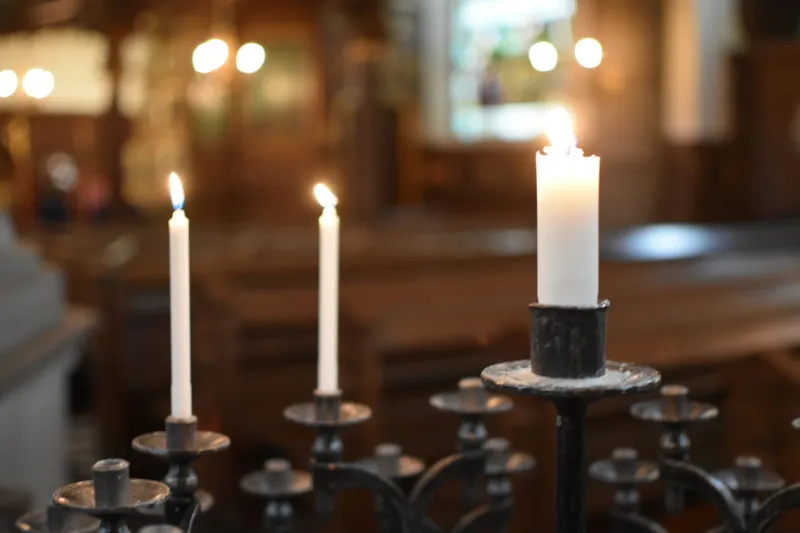
Create a physical threshold. Monasteries ring bells to mark the transition into night prayer. In a home, this might mean lighting a candle, dimming the lights, or placing a small icon or crucifix at a designated spot. The body responds to environment; a small ritual of transition signals to the whole person that something different is beginning.
Guard the silence before sleep. Many parishioners who have developed a night prayer practice speak of the importance of protecting the thirty minutes following Compline from screens and stimulation. This is not legalism — it is simply recognizing that what fills the mind in the final moments before sleep tends to shape the interior life of the night.
Consider Lauds as its companion. Morning Prayer and Night Prayer form a natural pair — the Church's daily bookends. Those who pray both describe a sense of the entire day being held within a sacred frame. Even a simplified Lauds — a psalm, a Scripture verse, a brief intercession — can anchor the morning in a way that carries through to evening.
An Invitation from the Parish
St. Barbara's will be hosting a formation evening this season dedicated to the Liturgy of the Hours, open to all parishioners who wish to learn more about this treasury of Catholic prayer. Details will be published in the parish bulletin and on the parish website. The evening will include a communal praying of Vespers and Compline, a brief catechetical presentation, and time for questions.
In a culture that rarely sleeps and almost never stops, the invitation to vigil prayer is a radical one. It asks us to believe that the most important thing we can do with a quiet hour is not to optimize it, but to offer it. St. Barbara, whose witness was forged in confinement and darkness before her martyrdom brought her into eternal light, knew something about the sanctity of the unseen hours. Her intercession accompanies every parishioner who dares, in the stillness of a Santa Barbara night, to keep watch.