Conscience Over Compliance: What St. Barbara's Defiance Teaches Modern Catholics About Moral Courage
A Choice That Cost Everything
Most of us will never face the precise circumstances that defined St. Barbara's final days on earth. We will not be imprisoned in a tower by a pagan father, nor will we be asked to renounce our faith under threat of execution. And yet the essential tension at the heart of her story — the conflict between institutional authority and personal moral conviction — is one that Catholics across the United States encounter in varying forms every single day.
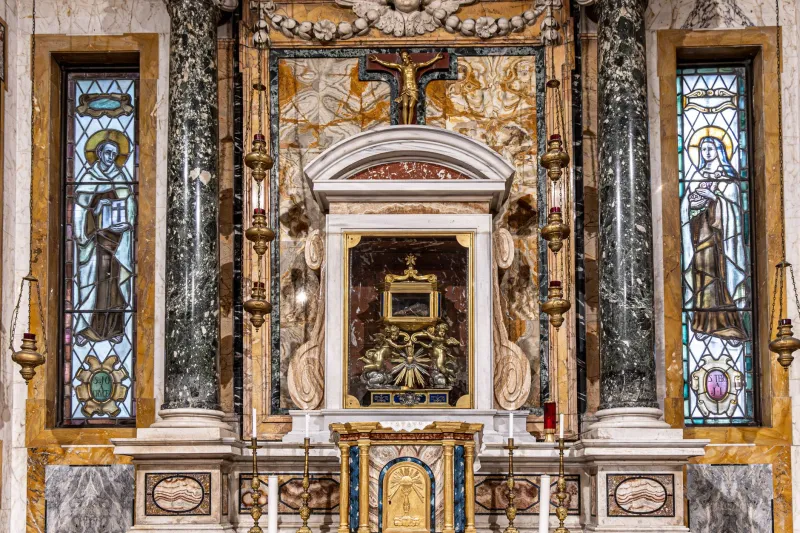
St. Barbara, according to the accounts passed down through centuries of tradition, was a young woman of remarkable intellectual and spiritual independence. Born to a wealthy pagan father named Dioscorus, she was kept secluded from the world, yet she used that solitude not for idle comfort but for contemplation. She studied the natural world, observed the heavens, and arrived — through the exercise of reason and grace — at the conviction that the God of the Christians was the one true God. When her father commissioned the construction of a bathhouse and specified two windows, Barbara insisted on three, later explaining that she saw in the Trinity the fullness of divine truth. It was a small architectural act, but it carried enormous theological weight.
What followed was not a family quarrel in the ordinary sense. It was a crisis of allegiance. Dioscorus, enraged by her conversion, handed her over to the Roman prefect Marcian, who subjected her to torture and ultimately ordered her beheading. Dioscorus himself, in some accounts, carried out the execution. Barbara faced this end not with defiance for its own sake, but with the calm certainty that she owed her ultimate fidelity not to her earthly father, but to her Father in heaven.
Obedience and Its Proper Order
Catholic moral theology has always maintained that obedience is a virtue — but not an absolute one. The Catechism of the Catholic Church is clear that citizens and subordinates are bound to obey legitimate authority, yet it is equally clear that this obligation ceases when commands require acting against the moral law or the dictates of conscience. As the Catechism states, "The citizen is obliged in conscience not to follow the directives of civil authorities when they are contrary to the demands of the moral order" (CCC 2242).
St. Barbara understood this hierarchy intuitively, even without the benefit of a formal theological education. She recognized that her father's authority, however culturally sanctioned, did not extend to the governance of her soul. Her defiance was not willful pride — it was rightly ordered conscience.
This distinction matters enormously for Catholics navigating life in contemporary America. We live in a society that frequently asks us to compartmentalize our faith, to treat it as a private matter with no legitimate bearing on professional conduct, civic participation, or public witness. The pressure to comply — to go along with institutional expectations that contradict Catholic moral teaching — is real, pervasive, and often subtle.
When Modern Catholics Have Had to Stand Firm
Consider the experiences of Catholic healthcare professionals who, in recent years, have faced institutional mandates requiring participation in procedures they regard as gravely immoral. Nurses, pharmacists, and physicians across the country have filed conscience objections, accepted professional consequences, and in some cases pursued litigation — not because they sought confrontation, but because they believed, as Barbara did, that some lines simply cannot be crossed.
Consider also the Catholic social workers, educators, and nonprofit administrators who have faced pressure to implement policies or affirm positions that conflict with the Church's understanding of human dignity and the natural law. Many have chosen quiet resignation rather than silent complicity. Others have remained within their institutions to advocate for change from within — a different but equally legitimate form of moral witness.
And consider the growing number of Catholic business owners who have navigated the difficult terrain of operating according to their values in a marketplace that increasingly regards those values as unwelcome. Their situations are rarely as dramatic as Barbara's, but they share her fundamental predicament: a choice between accommodation and integrity.
What unites all of these examples is not a spirit of antagonism toward the broader culture. It is something more like what the philosopher Charles Taylor calls an "ethics of authenticity" — a commitment to living in accordance with one's deepest convictions, even at personal cost. For Catholics, that authenticity is not self-constructed; it is received, formed through Scripture, Tradition, and the teaching authority of the Church.
Activism Rooted in Love, Not Anger
It is worth pausing here to note what St. Barbara's witness does not teach us. It does not sanction reflexive defiance, performative outrage, or the reduction of Catholic identity to a set of political grievances. Barbara did not seek a platform. She did not court martyrdom. The accounts we have of her suggest a woman of interior depth, whose exterior courage flowed from a wellspring of genuine faith rather than from ideological passion.
This is a necessary corrective for any discussion of Catholic activism. The word "activism" carries connotations in our current cultural moment that can obscure more than they illuminate. True Catholic witness — the kind modeled by Barbara, by Dorothy Day, by Franz Jägerstätter, by the countless unnamed faithful who have held their ground in ordinary circumstances — is characterized first by love. Love of God, love of neighbor, love even of those who oppose us.
When Catholics in Santa Barbara and across the country engage the public square on matters of life, justice, immigration, the environment, or the dignity of the poor, they do so most faithfully when their engagement is animated by charity rather than contempt. The goal is never to win an argument; it is to bear witness to the truth in a way that opens hearts rather than hardens them.
Formation Before Action
Perhaps the most underappreciated aspect of Barbara's story is the period of formation that preceded her moment of decision. Her years of solitude and study were not wasted time — they were the foundation upon which her courage was built. She knew what she believed, and she knew why she believed it, before she was ever called upon to defend it.
This points to a practical imperative for our parish community. If we wish to be the kind of Catholics who can stand firm when the moment demands it, we must invest seriously in our own formation now, in the ordinary seasons when no crisis presents itself. That means engaging regularly with Scripture, with the writings of the saints, with the social teaching of the Church. It means participating in the sacramental life that sustains and strengthens us. It means gathering, as we do here at St. Barbara's, in communities of faith that hold us accountable and encourage us in the life of discipleship.
St. Barbara could not have faced her father and the Roman prefect without the interior life she had cultivated in solitude. We cannot face our own moments of moral reckoning without the interior life we cultivate together.
A Patron for a Complicated Moment
We are living through a period in American Catholic life that demands precisely the kind of courage our patron saint embodied. The challenges are different in form from hers, but not in essence. We are still being asked, in a thousand ways large and small, to choose between the approval of the world and the approval of God.
St. Barbara chose. And her choice, preserved in the memory of the Church across fifteen centuries, continues to instruct and inspire those who bear her name. May her intercession strengthen us to make our own choices with the same clarity, the same courage, and the same love that carried her through the flame.