Chosen with Purpose: The Patron Who Shaped a Parish and Still Speaks to Us Today
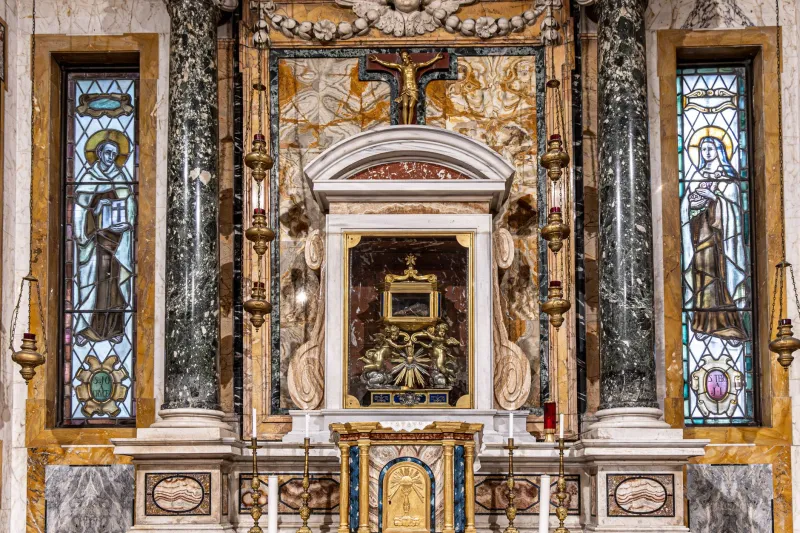
Every Catholic church carries a name that functions as more than an address. It is a theological statement, a spiritual lineage, and an act of intentional devotion. When the founders of what would become St. Barbara's Catholic Church affixed their patron's name to this community, they were doing something far more consequential than selecting a title for a building. They were binding themselves — and every generation of parishioners to follow — to a particular witness of faith.
For many who have worshipped here for years, or who have only recently found their way through our doors, the connection between the saint and the city may seem self-evident. Santa Barbara bears her name, after all, and the church simply follows the city's lead. But the full story is considerably richer, and considerably more instructive, than that convenient assumption allows.
How a Roman Martyr Came to Anchor a California City
The name Santa Barbara entered California's geography through the Spanish colonial and missionary enterprise of the late eighteenth century. When the Royal Presidio of Santa Barbara was established in 1782 and the mission followed in 1786, both were formally dedicated on or near the feast day of St. Barbara, which falls on December 4th. The Franciscan missionaries who shaped the spiritual character of Alta California were deliberate in their calendar-driven naming conventions. A settlement founded in proximity to a saint's feast day received that saint's patronage as a matter of custom and conviction alike.
St. Barbara herself was a Christian martyr of the early church, venerated across both Eastern and Western traditions. Her story, preserved through hagiographic accounts that date to at least the seventh century, places her in the third or fourth century of the common era — a young woman of exceptional intelligence and deep spiritual conviction who converted to Christianity against the will of her pagan father. The specific details of her life have been subject to scholarly debate, and the Catholic Church removed her from the universal liturgical calendar in 1969, acknowledging that historical certainty about her biography is limited. Yet her veneration persisted, and continues to persist, precisely because her story carries a truth that transcends verifiable biography.
The Spiritual Architecture of a Named Parish
When a parish adopts a patron saint, it is not merely borrowing a name. It is entering into a relationship of intercession, imitation, and spiritual kinship. The Catholic tradition holds that the saints in heaven are active intercessors, present to the needs of those who invoke them. To name a parish after St. Barbara is to place that community under her specific care — to ask, implicitly and explicitly, that she carry the prayers of this congregation before the throne of God.
For a church situated in a city that has long been home to military installations, first responders, and those whose daily work carries genuine physical risk, the patronage of St. Barbara carries particular weight. She has been invoked for centuries as the protector of those who face sudden death — artillerymen, miners, firefighters, and soldiers among them. The tradition connecting her to protection from violent and unexpected harm arose from the legendary account of her martyrdom, in which her father struck her down with his own hand. The lightning bolt that, according to tradition, subsequently killed him became, in the popular imagination, a symbol of divine justice and of St. Barbara's power over the forces that threaten human life.
This is not incidental to the identity of our parish. It is woven into the very name we bear.
What the Missionaries Understood That We Sometimes Forget
The Franciscan friars who dedicated the Santa Barbara mission were operating within a worldview in which the spiritual and material orders were inseparable. Naming a settlement after a saint was not merely a pious gesture; it was an act of civic and communal ordering. The patron saint was understood to be genuinely present to the community, genuinely protective of it, and genuinely worthy of regular, formal veneration.
Contemporary Catholic life in the United States has, in many respects, softened this sensibility. We are more comfortable, perhaps, with saints as inspiring historical figures than as living intercessors. The practical devotional life that once surrounded patron saints — the feast day observances, the novenas, the public processions — has diminished in many parishes, even as the names remain on the buildings.
To recover the full meaning of our patron's presence is not an exercise in nostalgia. It is an act of theological seriousness. St. Barbara's Catholic Church is not simply a community that happens to share a name with the city around it. It is a community that has been placed, by history and by deliberate spiritual choice, under the care of a martyr who refused to compromise her faith regardless of the cost.
What She Still Teaches Us
For families raising children in the faith, St. Barbara's story offers a striking and sometimes uncomfortable model. She did not inherit her Christianity from her father. She sought it, chose it, and defended it — at the cost of everything. In an era when faith formation often focuses, quite rightly, on the nurturing of belief within the family, her story is a reminder that faith must ultimately be personally owned. Parents may plant the seed, but the soil of the soul belongs to the individual before God.
For those who work in dangerous professions — the firefighters, the paramedics, the law enforcement officers who worship among us — her patronage is not a relic of medieval superstition. It is an acknowledgment that human beings who stand between safety and catastrophe deserve the specific, focused intercession of one who knew what it meant to face mortal threat with faith intact.
And for the parish as a whole, her story is a call to understand that the name above our doors is not decorative. It is a commission.
Honoring the Name We Bear
St. Barbara's feast day on December 4th offers this parish an annual opportunity to do more than simply acknowledge the date. It is an occasion to reflect, as a community, on what it means to worship under her patronage — to consider the ways in which her witness of courage, conviction, and fidelity speaks to the particular challenges facing Catholic families and individuals in Santa Barbara today.
The missionaries who first attached her name to this coast were building something intended to endure. The parish that carries her name into the present century inherits both the privilege and the responsibility of that choice. To know who she was, and why she was chosen, is to understand something essential about who we are called to be.