Around the Table Again: How St. Barbara's Families Are Rediscovering the Sacred Art of Conversation
There is an old saying, often attributed to the domestic church tradition, that the family table is the first altar a child knows. It is where bread is broken, where gratitude is spoken aloud, where the day's weight is set down and shared. Yet for many households across Santa Barbara and throughout the country, that table has grown quieter in a way that has nothing to do with peace — and everything to do with distraction.
Notification chimes. Streaming queues. The reflexive reach for a phone between bites. These habits have crept into the sacred rhythm of shared meals with remarkable speed, and their effect on family life is increasingly difficult to ignore. But within our own parish community, something is quietly pushing back.
A Parish Stirring Toward Presence
Over the past several months, a number of St. Barbara's families have spoken candidly with parish staff and ministry leaders about a shared longing: they want to actually talk to one another again. Not through text threads or group chats, but face to face, without the ambient noise of digital life filling every silence.
Maria and Thomas Delgado, parishioners who have attended St. Barbara's for nearly fifteen years, describe the turning point in their household as a simple but jarring observation. "Our youngest asked my husband a question at dinner," Maria recalls, "and he answered without looking up from his phone. She didn't say anything. She just went quiet. That silence was louder than anything."
What followed was not a dramatic overhaul but a series of small, deliberate choices — choices that, over time, have transformed their evenings into something the Delgados now describe as genuinely nourishing.
Starting With Prayer, Not Rules
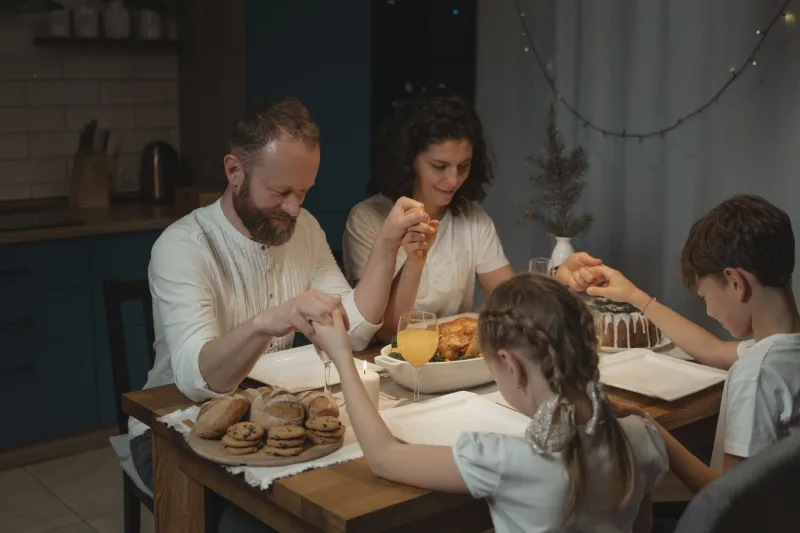
One of the most consistent themes among parishioners who have successfully reclaimed their dinner hour is that the shift began not with a technology ban, but with a return to prayer. Beginning the meal with a grace that is spoken slowly and attentively, rather than rushed through by rote, creates what several families describe as a threshold — a moment that signals a change in mode.
"When we actually pause and mean the words," says Catherine Okafor, a mother of four who participates in St. Barbara's Family Faith Formation program, "something settles. The kids stop fidgeting. We all take a breath. It sounds simple, but it genuinely changes the atmosphere at the table."
For families seeking to deepen this practice, our parish's Family & Faith Formation ministry recommends rotating prayer leadership among children old enough to participate. Allowing a child to choose a spontaneous prayer, or to name something they are grateful for before the formal grace, draws them into ownership of the ritual rather than passive endurance of it.
Conversation as a Form of Witness
Catholic tradition has long held that the domestic church — the family home — is the first and most formative place where faith takes root. This is not a metaphor. It is a theological conviction, articulated clearly in the documents of the Second Vatican Council and echoed in the teachings of every pope since. What we practice at home shapes what our children carry into the world.
With that in mind, the content of family conversation carries real spiritual weight. This does not mean every dinner must resemble a theology seminar. It means, rather, that families are invited to bring their whole lives — their joys, their struggles, their questions — to the table, and to receive one another with genuine attention.
Fr. James Moreno, one of St. Barbara's associate pastors, has observed this dynamic in his pastoral work with families across the parish. "The families I see thriving spiritually are rarely the ones who have the most structured faith programming at home," he notes. "They are the ones who have learned to be curious about each other. They ask real questions. They stay at the table long enough to hear the real answers."
Practical Strategies for the Busy Household
For families who feel the pull of this vision but struggle with the practical realities of busy schedules and habituated screen use, the following approaches have proven helpful for parishioners at St. Barbara's:
Designate the table as a screen-free zone. Rather than framing this as a prohibition, present it as a boundary that honors the people gathered. A simple basket near the kitchen entrance where phones are placed before sitting down can reduce the temptation to check devices without requiring ongoing negotiation.
Use conversation starter cards or question prompts. Several families in our parish have printed sets of questions drawn from the Gospel readings of the week, placing them in a small jar at the center of the table. Drawing one question per meal gives even reluctant conversationalists a concrete starting point.
Protect the length of the meal, not just its beginning. The depth of conversation rarely arrives in the first five minutes. Families who report the most meaningful exchanges are those who have made a habit of lingering — clearing plates slowly, remaining seated, allowing the conversation to find its own level.
Invite the day's difficulties, not only its highlights. A culture of authentic sharing at the family table requires that children and adults alike feel safe naming what was hard, confusing, or discouraging. This kind of honesty, received with patience rather than correction, builds the trust that makes deeper conversation possible over time.
Incorporate the liturgical calendar into table talk. Our parish's seasonal resources — available through the Family & Faith Formation office — offer simple conversation guides tied to the Church year. Discussing a saint's feast day, reflecting on an Advent or Lenten theme, or simply asking what a child noticed at Sunday Mass can anchor family conversation in something larger than the immediate week.
What Silence Can Teach
It is worth noting that reclaiming the dinner table does not mean filling every moment with words. Several parishioners have spoken about learning to sit with comfortable silence — something that has become increasingly rare in a world engineered to prevent it. Silence at the family table, when it is not the silence of disconnection but of mutual ease, is itself a form of communion.
This, too, is a spiritual practice. To be present to another person without the compulsion to perform, explain, or entertain is a quiet act of love. It is, in its own way, a form of prayer.
An Invitation
St. Barbara's Parish invites all families to consider what one small change might look like in your own home this week. Not a perfect solution, not a wholesale transformation — simply one deliberate choice to be more present to the people across the table from you.
Our Family & Faith Formation ministry offers resources, seasonal guides, and small-group support for families at every stage of this journey. We also welcome your stories. If your household has found ways to deepen connection through intentional conversation, we would be honored to hear from you and, with your permission, to share your experience with the wider parish community.
The table is waiting. So, we believe, is grace.