Her Own Soul to Answer For: What St. Barbara's Unyielding Spirit Teaches Catholic Women About Vocation and Agency
A Legend That Refuses to Stay Ancient
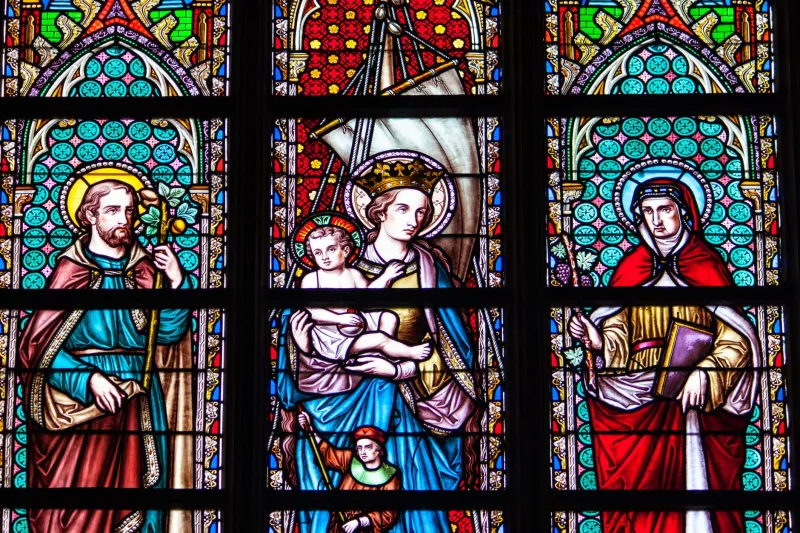
Most of us encounter St. Barbara through her patronage of artillerymen, miners, and those who work in the shadow of sudden death. Her tower with three windows is a familiar symbol in Catholic iconography, and her feast day on December 4th marks a beloved moment in the liturgical year here at St. Barbara's Parish. Yet beneath the well-worn imagery lies a dimension of her story that deserves far more attention than it typically receives — particularly among the women of our congregation.
St. Barbara, according to ancient tradition, was a young woman of remarkable beauty whose wealthy father, Dioscorus, sought to arrange her marriage to a man of his own choosing. He confined her to a tower, intending to shield her from the world while simultaneously controlling the terms of her future. What he did not anticipate was that his daughter would use that isolation not for passive waiting, but for active seeking. She turned her confinement into a cell of prayer, pursued knowledge of the Christian faith on her own initiative, and ultimately declared herself a consecrated follower of Christ — a decision that placed her irreversibly beyond her father's authority.
That act of spiritual self-determination cost Barbara her life. Her father, enraged by her conversion and her refusal to renounce it, ultimately handed her over to Roman authorities for execution. The tradition holds that Dioscorus himself struck the fatal blow. It is a story saturated in tragedy, yet the Church has venerated Barbara not as a victim but as a victor — a woman whose interior freedom no tower, no arranged marriage, and no paternal decree could extinguish.
The Difference Between Obedience and Surrender
Catholic teaching holds filial piety in high regard. Honoring one's father and mother is not merely a cultural nicety but a commandment, and the tradition of submitting to legitimate authority runs deep in our spiritual formation. It is worth pausing, then, to consider why the Church canonized a woman who openly defied her father's most cherished plans for her life.
The answer lies in a distinction that runs throughout Catholic moral theology: the difference between obedience rooted in love and surrender rooted in fear or coercion. St. Barbara did not rebel against her father out of selfishness or rebellion for its own sake. She refused him because his will directly contradicted what she understood to be God's claim on her life. In Catholic thought, no human authority — not even a parent — holds jurisdiction over a person's vocational response to God. When those two authorities come into conflict, the soul must answer to the higher one.
This is not a radical or novel teaching. It is the same principle that animated the martyrs, the same conviction that allowed Thomas More to say, famously, that he died the king's good servant but God's first. Barbara's story places that principle in the life of an ordinary young woman, not a bishop or a statesman, which is precisely what makes it so enduring and so relevant.
What This Means for Catholic Women Discerning Their Path Today
The women of St. Barbara's Parish live in a cultural moment that presents its own peculiar pressures. On one side, secular culture insists that a woman's fulfillment lies primarily in professional achievement and personal independence, often treating religious commitment as a limitation to be overcome. On the other side, well-meaning voices within Catholic communities can inadvertently reduce a woman's vocation to a narrow set of expected roles, applying social pressure that, while gentler than Dioscorus's tower, can feel no less confining.
St. Barbara's legend speaks into both of those pressures with equal force. Her story is not an argument for individualism — she did not seek freedom from God, but freedom for God. That distinction matters enormously. The autonomy her story celebrates is not the autonomy of self-creation but the autonomy of authentic response to a divine call that no external party can hear on another person's behalf.
For single Catholic women in particular, this message carries practical weight. The vocation of consecrated celibacy, of dedicated single life in service to the Church, or of patient discernment before marriage is not a lesser path or a temporary inconvenience. It is a legitimate, dignified, and often heroic response to God's invitation. Barbara's story reminds us that a woman who declines a marriage because she senses God calling her elsewhere is not being difficult — she is being faithful.
Reclaiming the Language of Discernment
One of the most practical gifts St. Barbara's story offers modern Catholic women is a vocabulary for conversations that can feel awkward or even contentious. When a young woman tells her family that she is not yet ready to pursue marriage, or that she is praying about a vocation to religious life, or that she simply does not feel called to a particular relationship, she is not making a statement against love or family. She is making a statement for attentiveness — the same attentiveness that Barbara cultivated in her tower.
Our parish's Family & Faith Formation programs offer a number of resources for women navigating these conversations, including small-group discernment sessions facilitated by members of our pastoral staff. We also encourage women who feel the weight of external expectations to bring those feelings into their prayer life honestly, rather than suppressing them out of a misplaced sense of obligation.
St. Ignatius of Loyola, whose method of discernment has guided the Church for centuries, taught that genuine consolation — the deep, settled peace that accompanies a decision aligned with God's will — is a more reliable guide than social pressure or the fear of disappointing others. Barbara appears to have understood something very like this intuitively. Her interior certainty was not shaken by her father's anger, by the threat of imprisonment, or even by the prospect of death. That kind of rootedness is not stubbornness; it is sanctity.
A Patron Worth Knowing More Deeply
As the patron saint of this parish and of our community here in Santa Barbara, St. Barbara deserves to be known in the fullness of her story — not only as a distant intercessor for those in physical danger, but as a close companion for those navigating the quieter dangers of misplaced obligation, social conformity, and the slow erosion of interior freedom.
We invite the women of our parish, at every stage of life, to spend time with her legend this Advent season as her feast day approaches. Bring her story into your prayer. Ask her to intercede for the clarity she herself pursued in that tower — the clarity to hear God's voice above every other, and the courage to follow it wherever it leads.
Her tower had three windows, tradition tells us, and each one let in light. May her example open windows of discernment in every heart that seeks it.