When All Seems Lost: Turning to St. Barbara in the Hour of Greatest Need
There is a particular kind of suffering that resists easy consolation. It is the suffering that arrives not as a passing storm but as a long, unyielding darkness — a diagnosis without a clear prognosis, a marriage fraying at its edges, a faith grown so thin it barely holds the weight of a single prayer. In these hours, many Catholics find themselves uncertain where to turn, their usual spiritual routines feeling hollow, their petitions to God seeming to dissolve before they reach the ceiling.
It is precisely for moments such as these that the Church has always offered the communion of saints — and few saints speak more powerfully into impossible situations than the very patron whose name this parish bears.
A Life Forged in Refusal
The historical account of St. Barbara, while layered with the texture of ancient hagiography, carries within it a spiritual truth that transcends the centuries. Barbara was a young woman of extraordinary beauty and intellect, the daughter of a wealthy pagan nobleman in the third or fourth century. When her father sought to confine her — both literally, within a tower, and spiritually, within the boundaries of a life arranged entirely for his benefit — she refused. She pursued truth, came to embrace Christianity, and accepted baptism at tremendous personal risk.
When her father discovered her faith, he did not merely disown her. He became her persecutor, ultimately delivering her to the Roman authorities who subjected her to brutal torture before her execution. The accounts tell us that Barbara endured these trials with a composure that confounded her captors. She was not resigned to her fate in a spirit of defeat; she was anchored in a certainty that no earthly power could extinguish what God had ignited within her.
This is why the Church has long recognized St. Barbara as a patroness of those who face sudden, violent, or seemingly inescapable danger — and, more broadly, of all who find themselves in situations where human resources have been exhausted.
The Theology of Asking for Help
Some Catholics, particularly those who came to the faith as adults or who were formed in more evangelical Protestant traditions, occasionally wrestle with the practice of intercessory prayer through the saints. It is worth pausing here to clarify what the Church actually teaches, because the theology is both more straightforward and more beautiful than its critics sometimes suggest.
When we ask St. Barbara — or any saint — to intercede for us, we are not bypassing God. We are, rather, acknowledging that we belong to a Body that extends beyond the boundaries of earthly life. The Catechism of the Catholic Church reminds us that the saints "do not cease to intercede with the Father for us" (CCC 956). Their prayers, offered in perfect union with God's will, carry a weight and clarity that our own fragmented petitions often lack. Asking for their intercession is, in a sense, asking those who see God face-to-face to bring our needs before Him on our behalf.
St. Barbara, having herself endured the worst that human cruelty and circumstance could offer, is uniquely positioned to understand the prayers of those who feel cornered, afraid, or forsaken.
Voices from the Parish
The evidence of her intercession is not confined to ancient manuscripts. Within our own St. Barbara's community, parishioners have shared accounts of unexpected grace arriving in the midst of desperate circumstances.
One longtime parishioner, a woman who asked that her name not be used, described the period following her husband's sudden cardiac event two years ago. "The doctors were not optimistic," she recalled during a recent faith-sharing evening at the parish. "I sat in that hospital waiting room and I just started talking to St. Barbara. Not formally — I didn't have a prayer card with me. I just told her I was terrified and I needed help." Her husband recovered in ways that his medical team described as medically surprising. She is careful not to make sweeping claims, but she is equally unwilling to dismiss what she experienced as coincidence. "Something shifted in that waiting room. I felt less alone."
Another parishioner, a contractor who works in construction — one of the many dangerous professions for which St. Barbara is also recognized as a patron — described invoking her name before a particularly complex and hazardous project. "I'm not the most outwardly religious guy," he admitted with a quiet laugh. "But I said a prayer to St. Barbara before we started that job. Everyone came home safe. I'll keep doing that."
These are not extraordinary mystics. They are ordinary Catholics, living ordinary American lives in Santa Barbara, reaching for an ancient source of spiritual support when the ordinary measures proved insufficient.
Practical Ways to Seek Her Intercession
For those who wish to cultivate a deeper devotion to St. Barbara, the following practices offer accessible entry points, regardless of where you currently stand in your faith journey.
Pray the traditional prayer to St. Barbara. The Church's treasury of prayers to this saint is rich. A simple, traditional invocation asks for her protection and intercession in moments of danger and spiritual trial. Prayer cards are available at the parish office for any parishioner who wishes to keep one close.
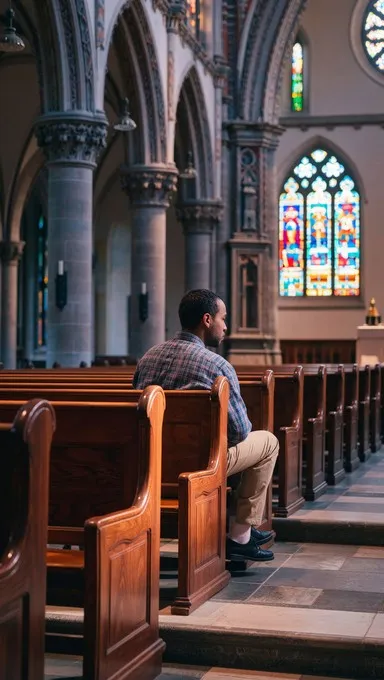
Visit the church in a spirit of petition. Our parish church, dedicated to St. Barbara's memory and witness, is itself a place of prayer. Spending quiet time before the Blessed Sacrament and asking St. Barbara to carry your intentions before God is a practice with deep roots in Catholic devotional life.
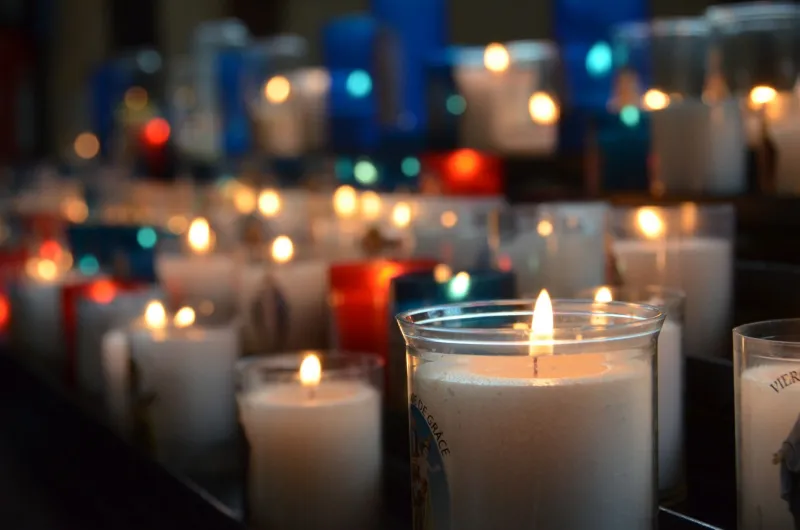
Light a candle and name your need. The simple act of lighting a votive candle in the church is more than a ritual gesture. It is an outward expression of interior petition — a way of saying, in the language of symbol, "I am placing this need in the light of God's presence and asking the saints to accompany it."
Join the parish's intercessory prayer group. St. Barbara's hosts a regular gathering of parishioners committed to praying for the needs of the community. Submitting your intention to this group means that your need is held in prayer by many, a practice the New Testament itself commends.
Read her story slowly. There is a particular kind of spiritual nourishment that comes from sitting with the life of a saint and allowing it to speak to your own circumstances. The account of St. Barbara's courage in the face of her father's betrayal and Rome's brutality has a way of reframing our own difficulties — not minimizing them, but placing them within a larger narrative of faith's ultimate triumph.
Grace Does Not Always Arrive as We Expect
It would be dishonest to suggest that invoking St. Barbara's intercession guarantees the outcome we desire. The history of Christian faith is populated with men and women whose most fervent prayers were answered not with deliverance from suffering but with the grace to endure it — and to be transformed by it. St. Barbara herself did not escape martyrdom. What she received was something the Roman authorities could not anticipate and could not take from her: a peace that surpassed understanding, a certainty that death was not the final word.
This, ultimately, is what her patronage offers to those who call upon her in their darkest hours. Not a guarantee of a particular outcome, but the companionship of one who has been to the furthest edge and found God waiting there.
Whatever impossible situation you are carrying today, you need not carry it alone. The doors of this parish — and the intercession of its patron — remain open.