The Desert Within: Finding Your Way Back When Prayer Feels Empty
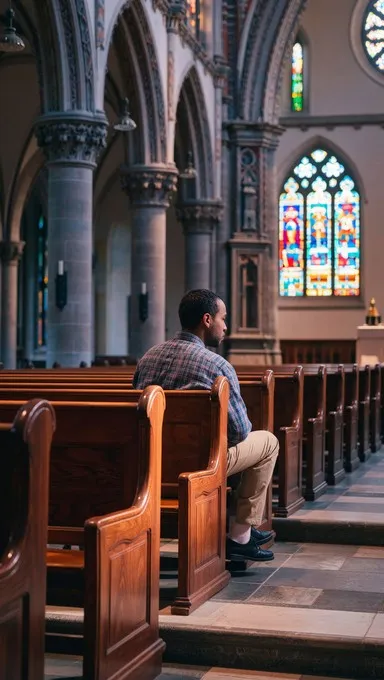
Photo: person praying alone in quiet church pew contemplative spiritual, via images.stockcake.com
When the Well Runs Dry
There is a particular loneliness that comes not from being without community, but from feeling spiritually hollow in the middle of it. You sit in the pew at Sunday Mass, surrounded by familiar faces, and something is missing—a warmth, a sense of presence, a feeling that the words you are saying have any purchase on the real. You kneel for your evening prayer and find yourself staring at the ceiling, words going nowhere, devotion replaced by duty.
If this sounds familiar, you are not alone, and you are not failing at faith. What you are experiencing has a name in the Catholic tradition: spiritual desolation. And the Church has been accompanying people through it for centuries.
This article is written for those in the middle of that experience—or for those who care for someone who is. It is an honest look at what spiritual dryness actually is, why it happens, and what faithful, practical steps can help you move through it.
What the Tradition Says: You Are in Good Company
Saint John of the Cross, the sixteenth-century Spanish mystic and Doctor of the Church, wrote extensively about what he called the "dark night of the soul"—a prolonged experience of spiritual aridity in which all the consolations of faith seem to be stripped away. His writings, though demanding, are ultimately a message of profound hope: the dark night is not abandonment. It is a form of purification, a deeper invitation into intimacy with God that cannot be reached while we are still dependent on spiritual feelings for our motivation.
Saint Ignatius of Loyola, founder of the Jesuits and architect of one of Catholicism's most practical spiritual systems, distinguished carefully between consolation—the experience of warmth, clarity, and peace in one's spiritual life—and desolation, its opposite. Crucially, Ignatius did not treat desolation as evidence that something had gone wrong. He treated it as a predictable part of the interior life that required specific responses, not panic.
Even figures as towering as Saint Teresa of Calcutta endured decades of spiritual dryness, a fact revealed only after her death through her private letters. Mother Teresa continued to serve, to pray, and to lead—not because she felt the presence of God, but because she had made a commitment that did not depend on feeling.
You are, in the very best sense, in good company.
Recognizing Desolation Without Catastrophizing It
One of the most damaging responses to spiritual dryness is the interpretation that it means something has gone permanently wrong—that God has withdrawn, that one's faith was never real, or that the Catholic life is simply not working. These interpretations are understandable, but they are almost universally mistaken.
Ignatian spirituality offers a helpful diagnostic framework. Desolation is typically characterized by some combination of the following: a sense of distance from God, diminished desire to pray, a pull toward spiritual discouragement or self-criticism, difficulty finding meaning in religious practice, and a weakening of hope. Recognizing these signs for what they are—a temporary weather pattern in the soul, not a verdict on one's faith—is the first and most important step.
It is also worth noting that spiritual dryness has several distinct causes, and identifying the source can shape the response. Sometimes desolation follows a period of intense spiritual consolation—a retreat, a powerful Mass, a significant life transition—and functions almost as a settling-in period. Other times it is connected to physical exhaustion, grief, or the chronic stress of American life, which does not leave the spiritual life untouched. Still other instances of dryness may be an invitation from God to move beyond surface-level devotion into something more mature.
Practical Steps for the Dry Season
Stay in the practice, even when it feels hollow. This is perhaps the most counterintuitive but most important piece of guidance the tradition offers. When prayer feels empty, the temptation is to stop praying until the feeling returns. Ignatius counsels the opposite: in times of desolation, maintain your spiritual commitments exactly as they were during times of consolation. Do not make significant changes to your prayer life based on how you feel in the moment. Show up. The discipline of faithfulness in dryness is itself a form of love.
Simplify your prayer. If your usual form of prayer has become a source of frustration, consider reducing rather than abandoning it. A single decade of the Rosary. Five minutes of quiet before a crucifix. The slow, attentive reading of a single psalm. The Liturgy of the Hours, even in abbreviated form, has sustained countless Catholics through dry seasons precisely because its structure does not depend on personal inspiration—it carries you when your own energy fails.
Speak it aloud—to a priest, a spiritual director, or a trusted friend. Spiritual dryness has a way of intensifying in isolation. Naming the experience to another person—particularly someone with spiritual formation—can break the grip of the narrative that something is permanently wrong. St. Barbara's parish offers access to pastoral care and can connect parishioners with spiritual direction. We encourage anyone experiencing prolonged desolation to reach out to our parish office.
Read the mystics, especially their accounts of struggle. The writings of Saint John of the Cross, Thomas Merton's Thoughts in Solitude, or even the accessible journal entries of Saint Thérèse of Lisieux can provide the particular comfort of recognition: others have been here, others have felt exactly this, and they came through.
Serve someone. This counsel comes from experience rather than theory. When the interior life feels dry, movement outward—toward a neighbor, a food pantry, a hospital visit, a phone call to someone lonely—often rekindles something in the soul that introspection alone cannot reach. The corporal works of mercy are not merely obligations. They are, for many Catholics in dry seasons, a form of prayer that the body can perform when the mind cannot.
When to Seek Additional Help
It is important to distinguish spiritual desolation from clinical depression, with which it can overlap significantly. If your experience of emptiness extends beyond your spiritual life into your ability to function, to experience ordinary pleasures, or to maintain relationships, please speak with a mental health professional. The Church has never held that spiritual practice is a substitute for appropriate medical or psychological care. Many Catholics find that addressing their mental health supports rather than competes with their spiritual growth.
Our pastoral care team at St. Barbara's is available to help parishioners navigate this discernment and to provide referrals to Catholic-friendly counselors in the Santa Barbara area when appropriate.
The Promise on the Other Side
Saint John of the Cross wrote that the dark night, however painful, is ultimately a passage—not a destination. The spiritual tradition of the Church is unanimous on this point: seasons of dryness, faithfully endured, tend to yield a faith that is more resilient, more honest, and more deeply rooted than the faith that preceded them.
The God who feels absent in the desert has not moved. And the desert, as every mystic and every honest believer eventually discovers, is also a place of encounter.
If you are in a dry season, hold on. Keep showing up. And know that your parish community walks with you.