Roots in Sacred Soil: The Catholic Foundations That Gave Santa Barbara Its Soul
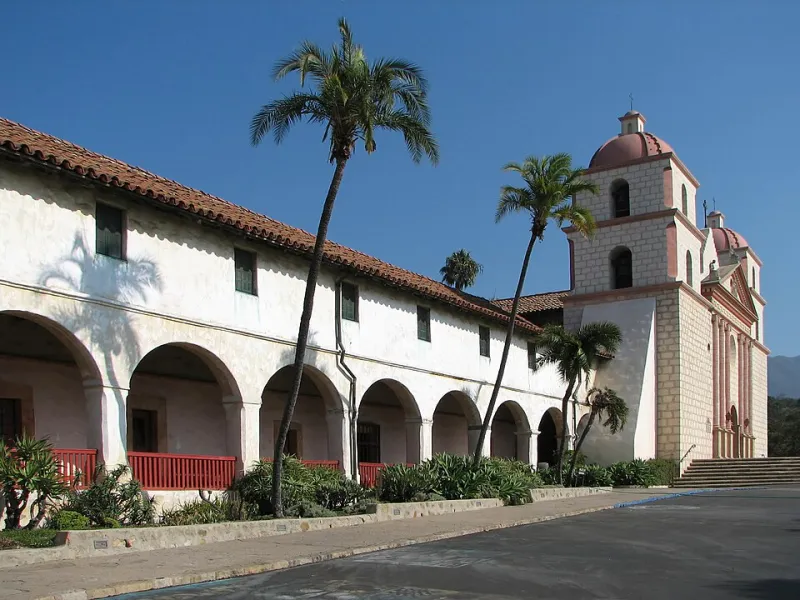
Photo: Bernard Gagnon, CC BY-SA 3.0, via Wikimedia Commons
There is something quietly remarkable about living in a city named for a saint. Every time a resident gives their address, every time a visitor reads a highway sign, the name of Saint Barbara echoes across the landscape—a persistent reminder that this place was consecrated, in spirit if not in ceremony, to a woman of extraordinary faith. For members of St. Barbara's Catholic Church, that connection is not incidental. It is foundational.
To understand who we are as a parish community, it helps to understand who came before us—and why they chose to build here.
The Franciscan Vision That Shaped a Region
The story of Catholic Santa Barbara begins in earnest on December 4, 1786, when Father Fermín Francisco de Lasuén, alongside a small company of Franciscan friars, established Mission Santa Barbara on the feast day of Saint Barbara herself. The timing was deliberate. The missionaries who traveled the California coast under the direction of Father Junípero Serra and his successors carried with them a deeply sacramental understanding of time and place. Feast days were not simply calendar markers; they were moments when heaven and earth drew close.
The mission they built—still standing today just a short distance from our parish—became known as the "Queen of the Missions" for its graceful architecture and enduring influence. But the Franciscans were not architects first. They were evangelists, educators, and community builders. They established schools, agricultural systems, and sacramental rhythms that would outlast the Spanish colonial era and survive the upheavals of Mexican independence and American statehood.
For modern parishioners, this history carries a complex weight. The missionary period involved real suffering for the indigenous Chumash people, whose own sacred relationship with this land predates the arrival of the friars by thousands of years. An honest engagement with Catholic heritage in Santa Barbara must hold both truths: the genuine faith and sacrifice of the missionaries, and the painful disruption their presence caused. The Church's own recent calls for reflection on this legacy invite us to approach our history with humility as well as gratitude.
Saint Barbara: Patron, Protector, and Parish Namesake
Who was the woman for whom this city—and our parish—is named? Saint Barbara's life, as preserved in Christian tradition, is one of remarkable courage. A young woman of the third or fourth century, she is said to have converted to Christianity in secret, defying a pagan father who ultimately betrayed her to Roman authorities. She was martyred for her faith, refusing to renounce Christ even under severe persecution.
Because her father was subsequently struck by lightning—understood by early Christians as divine judgment—Saint Barbara became the patron of those who face sudden or violent death: soldiers, miners, firefighters, and others who labor in dangerous circumstances. Her feast day, December 4, has been observed across centuries and continents.
For the Franciscan missionaries who arrived on that feast day in 1786, naming their new mission in her honor was an act of theological intention. They were not merely commemorating a calendar date. They were placing their endeavor—and the community they hoped to build—under the patronage of a woman who had chosen God over comfort, over family loyalty, and over life itself. That is a weighty inheritance for a parish to carry.
From Mission Walls to Parish Life
The decades following the mission's founding saw Santa Barbara grow from a remote outpost into a regional center of Catholic culture. The mission's influence shaped the city's architecture, its calendar of public celebrations, and its sense of communal identity. Even as California passed through successive political transitions, the Catholic presence in Santa Barbara remained a constant thread.
By the time St. Barbara's Catholic Church was formally established as a parish distinct from the mission, the community it served already possessed deep roots. Generations of Catholic families had been baptized, married, and buried within the traditions that the Franciscans had introduced. The parish did not create a Catholic community in Santa Barbara so much as it gave formal structure to one that already existed.
Today, when a family brings an infant to the baptismal font at St. Barbara's, they are participating in a rite that has been performed in this city for well over two centuries. When our congregation gathers for Mass on December 4 to honor our patron, we are joining a procession of worshippers that stretches back to those first friars kneeling in the California sun.
History as a Living Resource for Faith
It would be easy to treat this history as a museum exhibit—something to admire from a distance, safely separated from the demands of contemporary life. But the Catholic tradition has never understood history that way. The Communion of Saints, one of the central affirmations of our Creed, insists that those who have gone before us in faith are not simply gone. They remain present to the Church in a way that transcends ordinary time.
This means that Saint Barbara is not merely a figure on a stained-glass window. She is, in the Church's understanding, a living intercessor—someone who hears our prayers and carries them before God. The missionaries who built this city's spiritual foundations are not simply historical actors. They are fellow members of the Body of Christ, whose labors we have inherited and whose example continues to challenge us.
For parishioners seeking to deepen their faith, engaging with this history is a genuinely spiritual practice. Consider visiting Mission Santa Barbara and spending time in prayer within its walls. Read about the life of Saint Barbara and reflect on what her courage might ask of you in your own circumstances. Talk with your children about why this city carries a saint's name, and what that name might mean for how your family lives here.
Carrying the Legacy Forward
Santa Barbara's Catholic heritage is not a finished story. It is a story that each generation of parishioners is invited to continue. The same impulse that drove Franciscan missionaries across an ocean and up an unknown coastline—the desire to share the Gospel, to build community, to serve those in need—is the impulse that animates every ministry at St. Barbara's today.
When our parish volunteers staff the food pantry, teach religious education, or sit with the grieving, they are doing what Catholic communities in this place have always done. When our families gather for the December feast of Saint Barbara, they are renewing a connection that began before the United States existed.
The saints who built Santa Barbara did not build it for themselves. They built it for us—and we are building it, in turn, for those who will come after. That is what it means to belong to a tradition. That is what it means to be a parish.
For more information about the history of Mission Santa Barbara or to learn about upcoming events honoring our patron saint, please visit our parish office or speak with a member of our pastoral staff.