Faith at the Kitchen Table: How St. Barbara's Families Are Raising Catholic Children in Everyday Life
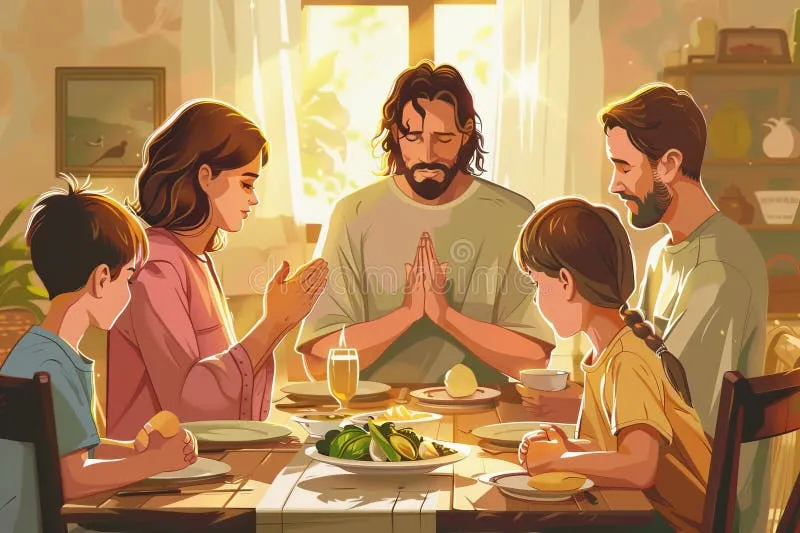
Photo: Catholic family praying together at dinner table children, via thumbs.dreamstime.com
There is a long-standing Catholic conviction that the family is the "domestic church" — a small but essential community in which the faith is first encountered, practiced, and loved. It is a beautiful idea, but any parent who has tried to lead a mealtime blessing while simultaneously preventing a toddler from launching a spoonful of pasta across the room knows that the domestic church can be a wonderfully chaotic place.
At St. Barbara's Catholic Church, parents are not expected to have it perfectly figured out. What they are invited into is a community of practice — a parish family in which mothers, fathers, and caregivers share what is working, admit what is not, and encourage one another in the slow, patient work of raising children in the faith. We spoke with families across the parish about the specific strategies they have found most meaningful, and we gathered additional perspective from our parish clergy. What follows is not a prescription, but an honest and practical collection of approaches that real families are using, right here in Santa Barbara.
1. Anchor the Day With Prayer — Even When It Is Brief
The most consistent piece of advice across every family we spoke with was this: pray daily, but do not let the perfect become the enemy of the good. For the Castellano family — parents Marco and Lucia, with three children between the ages of four and eleven — the anchor is a simple morning offering recited together before the school run begins.
"It takes about forty-five seconds," Lucia says with a laugh. "But it sets a tone. The kids know that before we go out into the world, we acknowledge who we are and whose we are. That matters."
Father James Whitmore, St. Barbara's Director of Faith Formation, affirms this approach wholeheartedly. "Parents sometimes feel they need to create elaborate prayer experiences, and those have their place," he notes. "But the daily rhythm of brief, sincere prayer is actually more formative than occasional grand gestures. Children absorb what they see repeated."
Bedtime prayers offer a second natural anchor point. Several families described the practice of ending the day with an examination of conscience — a simplified version adapted for children, in which each family member names one thing they are grateful for and one thing they wish they had done differently. It is a habit rooted in the Ignatian tradition and one that teaches children to reflect on their actions in light of their values.
2. Make Mealtime a Ritual, Not a Routine
For the O'Brien household — parents Kevin and Sara, with four children — the dinner table is the most important piece of furniture in the house. Grace before meals is non-negotiable, but the family has added layers of meaning over the years. On Sundays, they light a candle at the table and Kevin reads a brief passage from that day's Gospel, inviting the children to share one thing they noticed during Mass.
"It keeps the Mass from being something that just happens and then evaporates," Sara explains. "The kids start to see that what happens at church connects to what happens at home. They are not two separate worlds."
Father Whitmore encourages families to use the liturgical calendar as a guide for mealtime traditions. "During Advent, perhaps you set out a small Advent wreath. During Lent, you simplify the meal. These are small gestures, but they teach children that time itself has a sacred shape."
3. Introduce the Saints as Friends, Not Legends
One of Catholicism's greatest gifts to children is its vast treasury of saints — men and women of every personality, background, and era who lived the faith in concrete, often dramatic ways. Several St. Barbara's families have made the saints a regular presence in their homes, not as distant figures of piety, but as relatable companions.
The Nguyen family celebrates each child's patron saint feast day with a small party — a special meal, a candle, and a brief sharing about who that saint was and what made them remarkable. "Our daughter is named Clare, so we celebrate the feast of St. Clare of Assisi every August 11th," says mother Theresa Nguyen. "She loves it. She knows more about St. Clare than most adults do. And she has started asking about other saints on her own."
Parish families also recommend the illustrated saint biographies published by Ignatius Press and the "Saints Stories for Kids" podcast as accessible entry points for younger children.
4. Let the Liturgical Seasons Shape Your Home
The Church's liturgical calendar is one of the most distinctive and underutilized resources available to Catholic families. Rather than allowing secular cultural rhythms to dominate the year, families at St. Barbara's are reclaiming Advent, Lent, Ordinary Time, and the great feasts as the primary framework for their household life.
For the Flores family, Lent is the most intentional season of the year. Parents Jorge and Ana involve their children in choosing a family sacrifice and a family act of charity for the forty days. One year, the family gave up screen time on Fridays and spent that time volunteering at a local food bank. "The kids complained at first," Jorge admits. "By the end of Lent, they were asking if we could keep going. That was a grace."
Advent, meanwhile, is a season that St. Barbara's actively supports with parish resources, including an Advent prayer guide for families distributed at the start of each liturgical year. The guide includes daily reflections, simple activities for children of different ages, and suggestions for acts of service that connect the season of waiting to the needs of the broader community.
5. Attend Mass Together — and Talk About It Afterward
This may seem obvious, but several parents emphasized that regular, consistent Mass attendance — followed by genuine conversation about what was heard and experienced — is irreplaceable. The key, multiple families noted, is to make the conversation feel natural rather than didactic.
"We do not quiz the kids on the homily," says Maria Sandoval, mother of two. "We just ask, 'Was there anything that stuck with you today?' Sometimes they say no. Sometimes my eight-year-old says something that completely stops me in my tracks."
For families with younger children, St. Barbara's Children's Liturgy of the Word program — offered during the 10:00 a.m. Sunday Mass — provides an age-appropriate engagement with the readings that children can then share with their parents over lunch.
6. Be Honest About Your Own Faith Journey
Multiple parents at St. Barbara's mentioned something that may be the most countercultural item on this list: the importance of letting children see their parents' genuine faith, including its questions and uncertainties. Rather than presenting a polished, doubt-free version of belief, these parents speak honestly about their own struggles and what keeps them returning to the Church.
"My teenager asked me once if I ever doubted God's existence," recalls father Patrick Brennan. "I told him the truth — that I have, and that I find the question worth sitting with rather than shutting down. He looked at me differently after that. I think he realized faith was something real and alive, not just a box we tick."
Father Whitmore strongly endorses this approach. "Authentic faith is not the absence of questions. When children see parents wrestling honestly with belief and still choosing to practice, they learn that faith is robust enough to hold their questions too."
7. Engage With the Parish Community Beyond Sunday Mass
Finally, every family we spoke with emphasized that the domestic church does not function in isolation — it is sustained and enriched by connection to the wider parish community. Whether through involvement in St. Barbara's volunteer ministries, attendance at parish festivals and community events, or enrollment in the parish's religious education programs, families find that belonging to something larger than their own household deepens their children's sense of Catholic identity.
"My kids know they are part of something bigger than our family," says Lucia Castellano. "They know the priests by name. They know the families in the pew next to us. That is not incidental to their faith — it is the faith, lived out."
St. Barbara's offers numerous points of entry for family engagement throughout the year. We invite all parish families to visit the parish office or explore our website for information on upcoming programs, seasonal events, and volunteer opportunities designed with families in mind. The domestic church is strongest when it knows it is not alone.