Broken and Beloved: How St. Barbara's Story Offers a Path Back to God for Those Who Have Wandered
There is a particular kind of loneliness that belongs to those who once knew the consolations of faith and then, through circumstances both chosen and unchosen, found themselves standing outside the door of the Church, uncertain whether they were welcome to knock again. Perhaps it was a period of quiet rebellion in young adulthood. Perhaps it was grief so heavy that prayer seemed absurd. Perhaps it was a moral failure so significant that the thought of returning to the sacraments felt like an act of audacity rather than humility.
Whatever the shape of that distance, our parish's patroness has something to say to you.
St. Barbara's story is not simply a tale of heroic martyrdom frozen in the third century. It is, at its most essential, a story about someone who turned — who redirected her entire life toward God in a world that demanded she do otherwise. The theological term for this movement is metanoia, the Greek word for repentance that literally means a turning of the mind and heart. Every Catholic who has ever stepped back into a confessional after years away, or knelt again at a pew they once abandoned, has made that same turn. St. Barbara, we believe, walks beside them.
A Patron for Those Who Know What It Means to Start Over
The popular imagination tends to reduce St. Barbara to her iconography: the tower with three windows, the cannon at her feet, the palm of martyrdom in her hand. These symbols speak to her traditional patronage over soldiers, miners, and those who face sudden death. But within the broader tradition of Catholic devotion, Barbara has long been invoked by those who stand at life's most consequential turning points — moments when the old life must be surrendered and something new, however fragile, must be built in its place.
Her own conversion, according to the hagiographic accounts that have shaped centuries of devotion, was not a gradual, comfortable drift toward faith. It was a rupture. She encountered the truth of Christianity and could not unknow it. That encounter cost her everything, including, ultimately, her life. For Catholics who have experienced their own ruptures — the marriage that ended, the addiction that consumed years, the anger at God that went unspoken for too long — Barbara's willingness to begin again from a place of total vulnerability is not merely admirable. It is instructive.
What the Theology of Mercy Actually Requires of Us
One of the most persistent obstacles to returning to the practice of faith is a subtle but devastating theological error: the belief that one must be worthy before approaching God. This misconception, perhaps more than any other, keeps Catholics in the purgatory of their own making — convinced that they must first repair themselves before they can receive the grace that would actually enable that repair.
The Church's teaching on mercy, rooted in Scripture and expressed most vividly in the parable of the prodigal son, insists on the opposite sequence. The father in that parable does not wait for his son to arrive clean and composed. He sees him while he is still a long way off and runs. Grace precedes the full work of conversion; it does not follow it.
Fr. Michael Reyes, who serves as one of our parish's associate pastors and has spent years accompanying Catholics through the process of returning to the sacraments, describes this dynamic with pastoral directness. "The people who come to me after years away are almost always convinced they have to explain themselves before God will have them back," he has shared in parish settings. "What I try to help them understand is that the explanation is the prayer. Showing up is already an act of faith."
Practices That Open the Door
For parishioners who feel called to rebuild their relationship with the Church but are unsure where to begin, the following practices have proven meaningful within our community.
The Examination of Conscience as an Act of Compassion. Many Catholics associate the examination of conscience solely with preparation for Confession, and while that remains its primary purpose, it can also serve as a gentle, private act of honesty that precedes the formal sacrament. Sitting quietly with your history — not to condemn yourself, but to see clearly — is itself a form of prayer. St. Barbara's parish offers printed guides for this practice in the vestibule of the church, and our pastoral care team is available for anyone who would like to walk through this process with a companion.
Returning to the Rosary Without Pressure. For many fallen-away Catholics, the Rosary carries complicated memories: childhood obligations, rote recitation without understanding, or the sense of spiritual inadequacy when the mind wanders. Approaching the Rosary again, slowly and without self-judgment, can be a surprisingly gentle re-entry point into prayer. Even a single decade, offered imperfectly, is an act of reaching toward God.
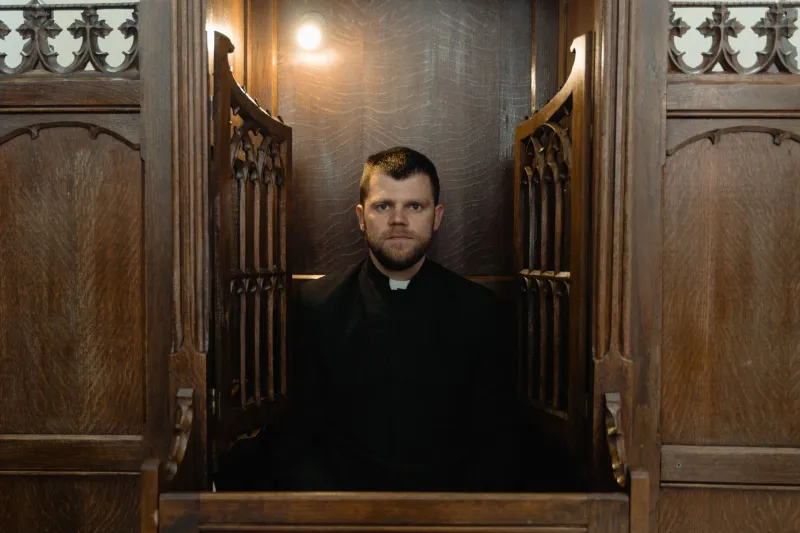
Seeking the Sacrament of Reconciliation. There is no substitute for this sacrament, and the Church's consistent teaching is that it is available to all Catholics who approach it with sincere contrition, regardless of how long they have been away or what they need to confess. Our parish offers Reconciliation every Saturday afternoon, and our priests are also available by appointment for those who prefer a more private setting.
Finding a Spiritual Companion. Conversion and renewal are rarely solitary endeavors. Our parish's pastoral care ministry includes trained spiritual directors and a peer accompaniment program that connects parishioners navigating periods of spiritual rebuilding with others who have made a similar journey.
Voices from Our Community
The most persuasive arguments for the possibility of renewal are not theological propositions but human stories. Within our parish, there are men and women who can speak with quiet authority about what it meant to return — to walk back through the doors of a church after a decade of absence, to kneel in a confessional trembling with both shame and hope, and to discover that the God they feared had grown distant was, in fact, the same God who had never moved.
One parishioner, a woman in her mid-fifties who asked to remain anonymous, described her return to the Church after twenty years away as feeling "less like a homecoming and more like being found." She had not gone looking for God, she explained. She had simply stopped running, and the stillness that followed was filled with something she could only describe as presence.
Another member of our community, a man who came back to regular Mass attendance following a period of serious personal failure, spoke of the moment he first invoked St. Barbara's intercession. "I didn't know much about her," he admitted, "except that this church was named for her. But something about the idea that she had faced a moment where everything was on the line and still chose God — that got through to me when nothing else could."
The Door Is Open
St. Barbara's Church stands, as it always has, as a place of refuge and return. Whether you are a lifelong parishioner navigating a dry season in your prayer life or someone who has been away from the sacraments for years, the pastoral care ministries of this parish exist for you. The saint whose name we bear was not a figure of effortless holiness. She was someone who turned toward God at great cost and kept turning, even when everything around her demanded otherwise.
That same grace is available to you. The question our patroness puts to each of us is not whether we have fallen, but whether we are willing to rise.
For information about Reconciliation times, spiritual direction, or our returning Catholics ministry, please visit our Pastoral Care page or contact the parish office directly.